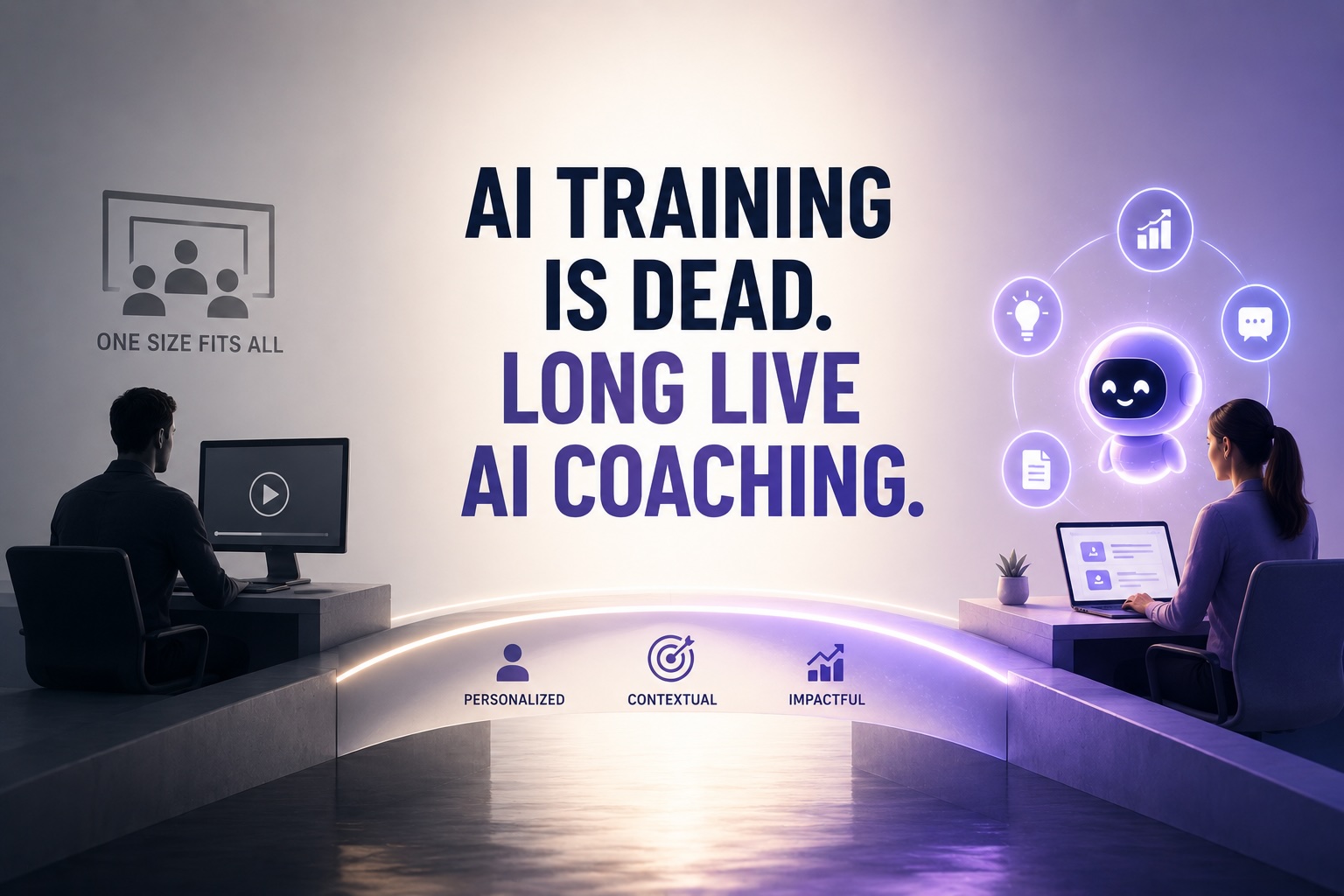
AI Training Is Dead. Long Live AI Coaching.
One of the most common questions I hear from leaders right now is surprisingly simple: “How do we train our teams on AI?”
On the surface, it sounds like exactly the right question. Every major technology shift over the past few decades came with some form of enablement program. Organizations trained employees on email, cloud software, CRM platforms, cybersecurity practices, and countless other technologies that transformed how businesses operate. The playbook was familiar. Develop training materials, schedule workshops, track attendance, measure completion rates, and move on to the next initiative.
Many organizations are approaching AI in exactly the same way.
The problem is that AI is not behaving like previous technology waves.
When we trained employees on a CRM system, we were teaching them how to use a tool. There was a relatively defined set of features, processes, and expected outcomes. Once employees learned how the system worked, the organization could largely consider the training complete.
AI is fundamentally different because it is not simply changing the tools people use. It is changing how people think, solve problems, make decisions, communicate, and create value. The challenge is not learning where to click. The challenge is learning how to work in partnership with a system whose capabilities are evolving almost continuously.
That distinction is incredibly important because it exposes a flaw in many AI adoption strategies. Traditional training assumes there is a stable body of knowledge that can be transferred from expert to learner. AI does not offer that stability. Models improve. New capabilities emerge. Workflows evolve. The most effective ways to use AI today may look very different six months from now.
As a result, many organizations find themselves trapped in a cycle of constantly updating training materials while employees continue discovering new use cases faster than formal learning programs can keep pace.
What makes this challenge even more complex is that AI’s value is highly contextual. Two employees using the same AI platform may derive completely different benefits from it based on their role, responsibilities, and business objectives. A finance analyst may use AI to accelerate reconciliations and month-end close processes. A project manager may use it to identify delivery risks earlier. A customer success manager may use it to uncover patterns in customer sentiment. A software developer may use it to accelerate testing and troubleshooting.
The technology is the same, but the value creation is completely different.
This is why I believe we are asking the wrong question.
The question is not how we train employees to use AI.
The question is how we help employees continuously discover better ways of working because AI exists.
That may sound like a subtle distinction, but it changes everything.
Training implies an event. Coaching implies a process.
Training assumes there is a finish line. Coaching assumes there is continuous improvement.
Training focuses on transferring knowledge. Coaching focuses on improving outcomes.
As I look at the organizations making the most meaningful progress with AI, I rarely see them treating AI enablement as a traditional learning initiative. Instead, they are increasingly embedding learning directly into the work itself. In many cases, they are beginning to use AI as the mechanism through which employees learn how to use AI more effectively.
Imagine a finance professional working through a month-end close process. Instead of leaving their workflow to search through documentation or revisit a training module, the AI becomes an active participant in the process. It identifies repetitive tasks, recommends automations, surfaces examples, explains reasoning, and suggests opportunities for improvement. The employee learns while performing the work. The coaching happens in context, precisely when it is needed.
This is a much more powerful model because adults rarely learn through information alone. They learn when information becomes relevant to a problem they are actively trying to solve.
Nobody wakes up excited to consume another mandatory training module. However, people become highly motivated when they discover a way to eliminate an hour of repetitive work from their day, improve the quality of a customer interaction, or complete a task in half the time. When AI helps create those outcomes, learning becomes self-reinforcing.
The most successful organizations are beginning to recognize this reality. Rather than building AI curricula around product features and prompt techniques, they are building enablement around business outcomes. They are teaching employees how to accelerate customer onboarding, improve forecasting accuracy, reduce operational waste, strengthen customer relationships, and make better decisions. The AI becomes a means to an end rather than the subject of the lesson itself.
This shift also forces leaders to rethink how they measure success. Many organizations continue to track AI adoption using the same metrics they use for traditional learning programs: training hours completed, certifications earned, attendance rates, and course completion percentages. While those metrics may indicate participation, they reveal very little about whether work is actually changing.
The metrics that matter are increasingly tied to outcomes. Has manual effort been reduced? Have cycle times improved? Has decision quality increased? Are customers receiving better experiences? Are employees creating new workflows that did not exist previously? These are the signals that indicate transformation is occurring.
Ultimately, I suspect the organizations that pull ahead over the next several years will not be the ones with the largest AI budgets or the most sophisticated models. They will be the ones that build continuous learning systems around AI. They will create environments where employees are constantly discovering, sharing, refining, and improving how work gets done.
Because AI adoption is not primarily a technology challenge.
It is a behavior challenge.
And behavior rarely changes because someone attended a workshop.
Behavior changes when people experience a better way of working and decide they never want to go back.
That is why I believe AI training, at least in its traditional form, is already beginning to fade. What is emerging in its place is something much more powerful: continuous coaching embedded directly into the flow of work.
And increasingly, that coach may be AI itself.